The proposed System Physics Advanced Reactor Critical (SPARC) facility at Idaho National Laboratory (INL) aims to address a significant gap in nuclear data for large and leaky system applications using a Horizontal Split Table (HST) assembly. The team created a conceptual design for a HST criticality experiment with a high sensitivity to molybdenum in the intermediate energy ranges.
Team: Andrew Johnson, Elliot Jeong, Grace Mahoney, Onur Taysi, and Sophie Rose
Project Advisor: Professor Dominik Fritz (RPI), Margaret Marshall, Matthew Lund, and Nicolas Woolstenhulme (Idaho National Laboratory)

Members of the design group
Project Motivation
Nuclear data is foundational in nuclear engineering calculations and is used in every nuclear discipline. We have made large strides with more accurate data being acquired with every new experiment performed. More progress, however, is always needed. Nuclear data is rather sparse for “large-and-leaky” systems, especially those driven by High Assay Low Enriched Uranium (HALEU) with high sensitivity to intermediate neutron energies. This data gap is primarily due to the lack of large-scale critical experiment capabilities. A new project referred to as the System Physics Advanced Reactor Critical facility (SPARC) plans to establish a Horizontal Split Table (HST) machine at the Idaho National Laboratory (INL) in the next few years which, among other objectives, will be able to support this type of experiment. This project proposed a potential configuration for the HST critical system that could be built at INL which focuses on clearing data gaps in the intermediate neutron range for natural molybdenum.
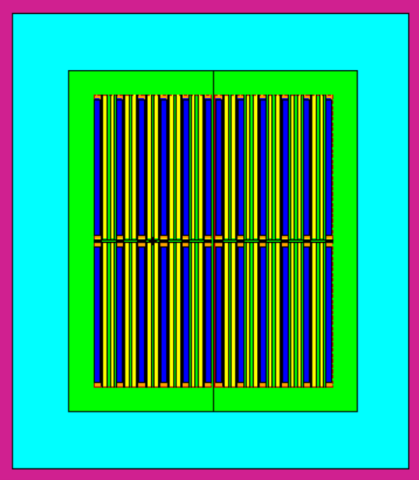
Depiction of Geometry for Final Critical System
Project Description
The team developed a conceptual design for a horizontal split table criticality experiment for use at Idaho National Laboratory. The experiment aimed to generate an intermediate energy neutron spectrum, with a primary focus on neutron energies between 0.5 - 50 keV, and achieved measurable sensitivity to molybdenum nuclear data. This energy range for molybdenum is one in which uncertainties in cross-section data currently pose a significant challenge to accurate modeling of advanced reactor systems. The experiment was designed to utilize uranium–molybdenum fuel, along with a selected reflector, a moderating material, and an additional form of molybdenum. Using an iterative MCNP-driven approach, the team evaluated and narrowed down moderator and reflector materials based on spectral-shaping performance, practicality, and INL guidance. HDPE was chosen as a moderator and graphite as a reflector because of their properties, cost-effectiveness, and material availability. A Python geometry generator was also developed to accelerate modeling workflows and support rapid design iteration in the fuel-moderator runs. A fuel-moderator-reflector system was tested in MCNP using KCODE to assess initial criticality, KSEN cards to evaluate sensitivities, and ENDF/B-VIII.0 nuclear data. Another Python script was created to plot the sensitivity of molybdenum in the system from MCNP output. This helped ensure our configuration worked towards our sensitivity goal. The fuel-moderator-reflector system was refined with cladding details, pure Mo, and expanded into a fully sized system and optimized to our criticality goal of k=1 and a minimum sensitivity goal of 0.001 over the 0.5-50keV energy range.
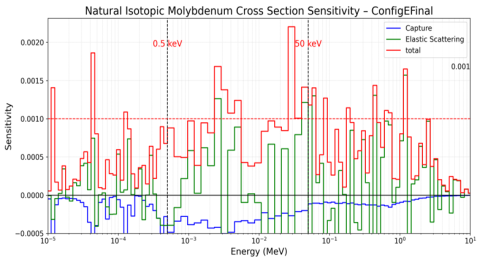
Sensitivity Profile for Final Critical System
Results and Accomplishments
The full critical MoST system achieves a criticality of 1.011347 keff and a Mo sensitivity profile of 0.015 over the 0.5keV-50keV range when the two horizontal tables are touching. The highest sensitivity peak is in the intermediate range, reaching above 0.0020. When the tables are 30cm apart (which will be the HST system fully separated) the system is subcritical with a keff of 0.872654, which is an important safety constraint.
The critical system was also run for two different simulations with material cards containing cross sections from ENDF 8.0 and 8.1, and then the keff and sensitivity profiles were compared. The results above are from ENDF 8.0, and the ENDF 8.1 keff when the two halves are touching is 1.01386. The keff values are the same to a hundredth decimal place. The sensitivity profiles show similar trends with slightly different peak height and placement between the two ENDF cross sections.