This project addresses that gap by allowing students and members of the public to interact with a model nuclear power plant and visualize the neutron chain reaction that takes place in modern fission reactors, as well as the safety features that make this reaction controllable
Team: Arthur Armstrong, Catherine Dolan, James Flyntz, Clara Gignoux, and Tate Ottenstein
Project Advisors: Professor Hyun Gook Kang (Rensselaer Polytechnic Institute) and Brett Siebert (Deep Fission)
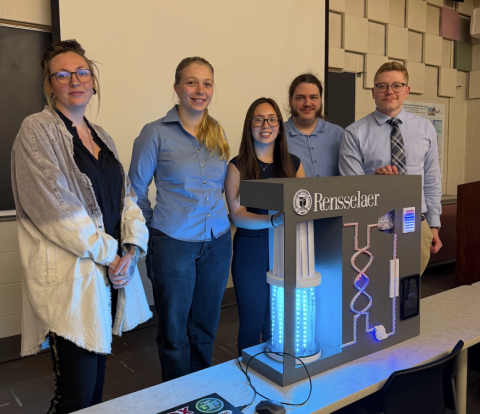
Members of the design group
Project Motivation
Nuclear power plays a critical and growing role in meeting global energy demands while reducing environmental impacts, especially as energy intensive technologies such as artificial intelligence and data centers continue to expand. Despite its importance, nuclear energy is not commonly represented in standard education, leaving many people with outdated and negative perceptions shaped by previous accidents. While these events remain crucial in future reactor design considerations, many people carry this negative connotation without understanding the fundamentals of nuclear power plant operation. This project addresses that gap by allowing students and members of the public to interact with a model nuclear power plant and visualize the neutron chain reaction that takes place in modern fission reactors, as well as the safety features that make this reaction controllable. Unlike traditional digital simulations, this hands-on approach fosters deeper learning and interest by visually demonstrating core reactor principles in an intuitive and accessible way.
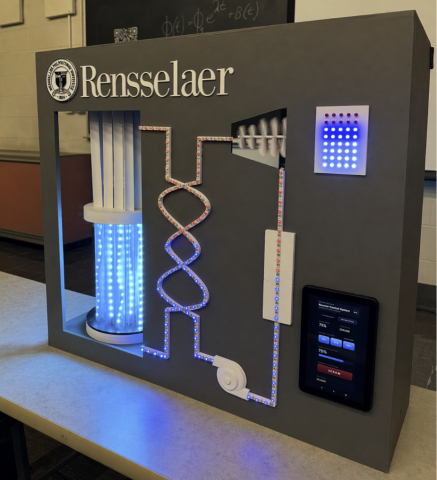
Reactor model created by the group
Project Description
The system uses a neutron-photon analogy to model reactor behavior, implemented through LED “fuel assemblies,” photoresistor feedback, and mechanically actuated control blades, to visually represent changes in reactor power and reactivity. It consists of five integrated subsystems: core structure, control rod drive, secondary loop, electronics, and a user interface.
The 21-assembly core includes 3D printed control blades that block light to demonstrate negative reactivity insertion, while phosphorescent paint simulates decay heat after a shutdown. A motor driven pulley system controls rod movement in staggered banks. The secondary loop represents feedwater, steam, turbine motion, and power generation using color-coded LED strips, a miniature fan, and successive generator light rows, respectively. The model’s electronics enable a light-sensor–based power feedback and a preliminary back-propagated control scheme that automatically adjusts rod position in response to user-set power changes. The user interface was constructed to communicate with the Arduino and initiate scenarios such as startup, shutdown, scram, and load-following. Together, these subsystems form a cohesive, interactive model that demonstrates reactor dynamics and plant behavior, serving as an engaging educational tool.
Results and Accomplishments
The project successfully developed a functional model that demonstrates key aspects of reactor operation. The integration of feedback and control enables the model to respond dynamically to defined user conditions, reinforcing key concepts of reactor and plant behavior. Scenarios such as startup, shutdown, scram and load-following can be executed smoothly, with coordinated responses across the model that enhance the educational value.
Building an accurate and functional model nuclear reactor required deep engagement with the fundamental principles of nuclear engineering, including neutron moderation, reactivity control, criticality, and decay heat. These concepts were translated into a physical analogue system through careful design of control blade geometry, photoresistor feedback logic, and system response behavior. Rather than relying on simplified visual representation, the model reflects how changes in reactivity influence core power and how these effects propagate throughout the system. Every subsystem, from the staggered control rod bank sequencing to the load-following control scheme, was grounded in actual reactor operating principles, resulting in a model that is both technically meaningful and intuitively understandable.