This project encompasses the complete design process of a high-temperature compact heat exchanger for Generation IV sodium fast reactors. The product provides the thermal interface between the liquid sodium primary coolant and a gaseous helium Brayton power conversion cycle for a laboratory-scale 20 kW thermal reactor
Team: : Jamie Murray, Kiel Rose, James Gefken, Jose Ignacio Vega
Project Advisor: Professor Shanbin Shi

Members of the design group
Project Motivation
The next generation of nuclear power plant technology under development by international collaborators aims to improve thermal efficiency compared to currently operating Pressurized Water Reactors and Boiling Water Reactors. Traditional shell & tube exchangers lack the compactness and high-pressure capability required for these extreme thermal environments. This environment pushes the physical limits of conventional materials and components due to resulting creep, thermal fatigue and corrosion. The design of the intermediate heat exchanger facilitating transfer of thermal energy to the power conversion cycle from within the reactor pressure vessel is therefore paramount to the overall safety and reliability of the entire plant. This component acts as a singular barrier separating the radioactive primary loop and the power cycle. The Sodium Fast Reactor in particular is attractive for its improved fuel utilization and potential fissile nuclide breeding capabilities. Sodium has much higher thermal conductivity than water at the same temperature and pressure, enabling higher power density within the reactor core.
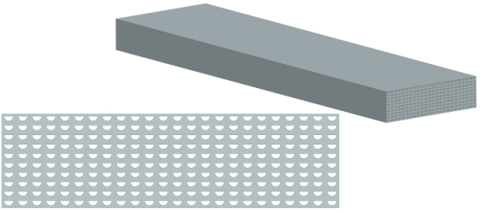
Dsigned heat exchanger
Project Description
The intermediate exchanger facilitates transfer of thermal energy from nuclear heat generation in the reactor core to the secondary power cycle. Compact heat exchangers aim to achieve high heat transfer efficiency by providing a large heat transfer surface area to volume ratio. This design requirement must be balanced with minimizing pressure loss across the component. From standard literature, the maximum allowable pressure loss across both sides was 50 kPa, but inclusion of a reasonable factor of safety set our preferred maximum less than 30 kPa. The minimum threshold to meet the technical definition of a Compact Heat Exchanger is 700 m2/m3, although requirements of economic viability result in most designs featuring 1000-4000 m2/m3. The design basis was scaled down from Idaho National Laboratory’s Industrial Sodium Cooled Fast Reactor to a research laboratory system preserving thermodynamic conditions but reducing power and flow rates. The helium Brayton cycle eliminates the risk of violent sodium-water chemical interaction. The selected printed circuit geometry consists of many microchannels chemically etched into metal plates and joined together by diffusion bonding. The fully welded structure of the PCHE is critical for this application because it greatly reduces the risk of coolant leaks and offers much higher mechanical strength required for thermal cycling in proposed facilities such as nuclear-renewable hybrid energy parks. An alternating-layer counterflow configuration was used to maximize thermal effectiveness.
Results and Accomplishments
Thermal-hydraulic benchmarking using INL’s design defined the operational temperature conditions for the sodium hot side (550°C inlet / 415°C outlet) and the helium cold side (112.75°C inlet / 535°C outlet), and the required heat duty of 20 kW. The team used the Logarithmic Mean Temperature Difference method to evaluate potential design concepts in SMath Studio and compared the preliminary results to the printed circuit design, which offered the best balance of compactness, minimal pressure losses and high-temperature compatibility. Then, they created a Python script to optimize channel diameter and channel count. The code accounted for varying heat transfer coefficient and friction factor correlations determined by laminar, transitional and turbulent regimes. The results revealed that both pressure drop and compactness decrease as diameter increases, posing a difficult tradeoff between opposing evaluation metrics. However, the team found that compactness remained relatively stable with increasing channel numbers due to the miniscule scale of the diameters evaluated, while the pressure loss decreased significantly. The final design features 1-mm diameter channels with a total of 240 channels (120 per fluid) distributed across 10 Stainless-Steel 316 plates. The final component dimensions are 3.6 cm x 1.0 cm x 14 cm. The compactness ratio achieved is 1714 m2/m3, and the resulting pressure losses are 29.9 kPa across the sodium side and 26.2 kPa across the helium side. Aspen Plus was used to validate the physics of hand calculations and the optimization script. The finalized design was found to successfully transfer the required 20 kW of thermal power. Finally, a presentation model of the component was fabricated using additive manufacturing.