The accuracy of nuclear data is a crucial contributor to the overall accuracy of a nuclear simulation. One way to improve that accuracy is to compare parameters like keff from physical experiments with simulated recreations of those experiments in what’s known as a benchmark. Using data from a benchmark experiment with prototype microreactor KRUSTY, this project seeks to identify interactions whose cross sectional uncertainties contribute most to overall keff uncertainty, evaluate ways to change KRUSTY’s properties to increase sensitivity to those interactions, and incorporate those changes into a proposed experiment design.
Team: Luke Watson, Aaron Sucov, Isadora Turbek, Addison Mulder
Project Advisor: Dr. Yaron Danon, Rensselaer Polytechnic Institute; Nicholas Thompson, Peter Brain, Noah Kleedtke, Los Alamos National Laboratory
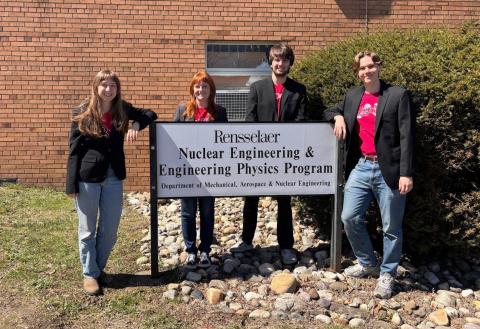
Members of the design group
Project Motivation
If simulation and computation are the brushes one uses to paint a still life, nuclear data is the suite of pigments to be employed. Even the best recreation of form and shading would fail to accurately capture the subject if the colors used are imprecise. Similarly, a brilliantly detailed recreation of design geometry in software like MCNP is unlikely to yield acceptable results if the data used to run the simulation is poor. While data libraries like ENDF B-VIII.1 provide precise values for an array of parameters necessary for simulation including energy- and nuclide-specific interaction cross section, gaps in precision for certain interactions and energy ranges remain. As such, the effort to reduce uncertainty in nuclear data is ongoing, and represents the core motivation of this project.
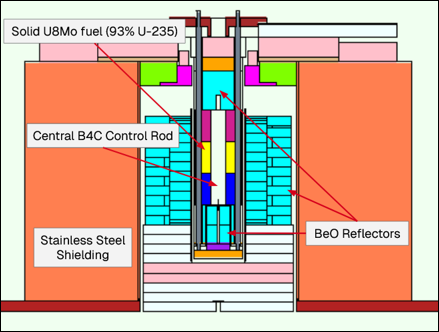
Geometry of the irradiation setup
Project Description
Analysis in this project was centered on the Kilopower Reactor Using Sterling Technology (KRUSTY), an assembly built at the Nevada National Security Site (NNSS) by scientists at Los Alamos National Lab (LANL). KRUSTY serves as a prototype for a class of space reactors with potential applications that include steady supply of electricity for crewed or robotic space missions, crewed Mars missions, and nuclear electric propulsion. Because of its unique purpose, the reactor features atypical components including a U8Mo core enriched to 93% U-235 and beryllium oxide reflectors.
The KRUSTY benchmarks used for this project were cataloged in the International Criticality Safety Benchmark Evaluation Project (ICSBEP) Handbook. Using MCNP with ENDF/B-VIII.1 nuclear data, keff and sensitivity coefficients could be generated. The analysis was focused on determining the key isotopes contributing to system uncertainty, which were found to be U-235, O-16, and Be-9. Based on these findings, many simulations were run with the intention of finding what changes to the geometry of KRUSTY resulted in increased sensitivity of these target isotopes. An objective function was also developed in order to rank the cost effectiveness and sensitivity effect of these system changes with the intention of proposing an experiment to reduce cross section uncertainties.
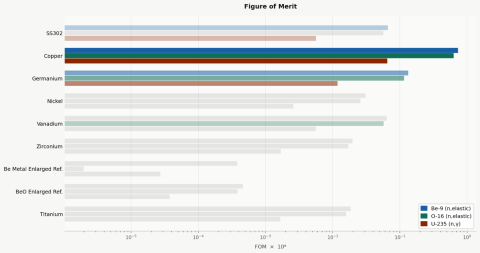
Objective Function Results by Interaction
Results and Accomplishments
The group designed an optimized configuration of the KRUSTY benchmark that maximizes neutron sensitivity to the key isotopes U-235, O-16, and Be-9 by replacing the stainless steel outer shields with copper, minimizes experimental cost by utilizing an existing copper shield already on-hand at LANL from previous experiments, and remains within the acceptable criticality bounds of 1.0 to 1.06 k-effective. Copper proved to be the most ideal material selection through the objective function ranking process, as it produces favorable neutron scattering properties while simultaneously reducing cost and logistical burden. This configuration will be proposed to LANL as a secondary diagnostic experiment aimed at reducing cross section uncertainties in nuclear data.